


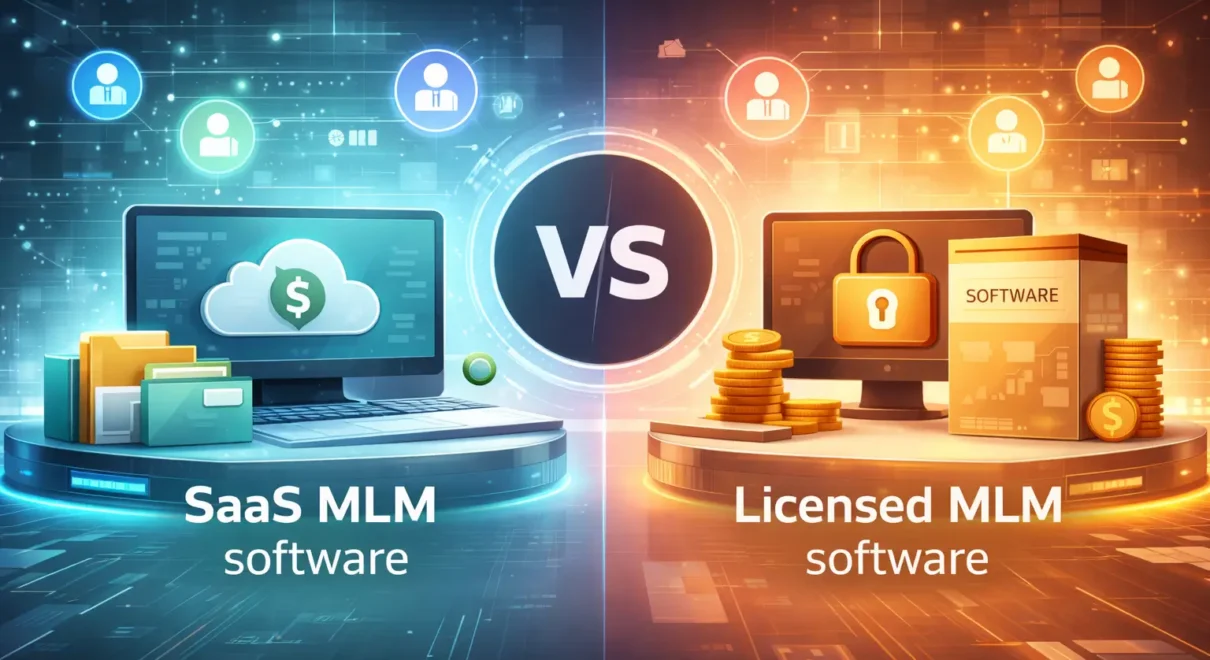
If you’re evaluating SaaS MLM software vs. licensed MLM software, you’re not choosing features, you’re choosing a growth model.
From our experience building MLM platforms for startups and enterprise networks alike, the right decision depends on how serious your long-term vision is. If you need speed, lower upfront cost, and minimal technical involvement, SaaS MLM Software can get you to market quickly. It’s practical, predictable, and operationally simple.
But if you’re building a scalable, investor-ready MLM business with complex compensation logic and aggressive expansion plans, licensed MLM software gives you control, ownership, and strategic flexibility. It requires more commitment, but it also removes long-term dependency risks.
In short: SaaS works for testing and early growth. Licensed works for building an asset.
The question isn’t what’s cheaper today. It’s what positions your MLM business correctly for the next five years.
Before you compare costs or scalability, you need clarity on what you’re actually buying.
Table of Contents
ToggleWhat is SaaS MLM Software?
- Cloud-based deployment managed by the provider
- Subscription pricing (monthly or annual)
- Hosted infrastructure with no internal server setup
- Automatic updates and feature rollouts
- Limited backend-level control
With SaaS, you’re essentially renting a ready-built ecosystem. We’ve seen it work well for companies that want to launch fast without building an internal tech stack. You reduce operational overhead, but you operate within the provider’s framework.
What is Licensed MLM Software?
- One-time license fee (with optional support contracts)
- Self-hosted or deployed on dedicated infrastructure
- Full ownership of the software instance
- Complete backend and logic customization
- Greater control over data and integrations
Here, you’re investing in long-term control. We typically recommend this model when scalability, flexibility, and strategic independence matter.
SaaS vs Licensed MLM Software : Detailed Comparison
Factor | SaaS MLM Software | Licensed MLM Software |
Pricing Model | Recurring subscription | One-time license + support |
Ownership | Vendor-controlled environment | Full instance ownership |
Customization | Limited to platform scope | Deep backend customization |
Time to Launch | Fast deployment | Longer setup cycle |
Maintenance | Managed by provider | Your team or dedicated support |
Security Control | Shared responsibility | Full infrastructure control |
Scalability | Platform-dependent | Infrastructure-driven |
“SaaS enables operational scale without infrastructure complexity. Licensed software enables strategic scale through ownership and deep control. The right choice depends on whether you want managed growth or engineered growth.”
Cost Analysis: Short-Term vs Long-Term ROI
Cost decisions in Custom MLM software solutions are rarely about price alone. They are about timing, control, and long-term financial exposure.

Upfront Cost:
SaaS requires minimal initial capital. You pay a subscription and go live quickly. Licensed software demands a higher initial investment that may include licensing, deployment, and infrastructure setup.
For early-stage ventures, this difference feels significant.
Recurring Cost:
SaaS operates as an ongoing operational expense. As your distributor network grows, pricing tiers often increase. Over three to five years, cumulative subscription fees can exceed the cost of ownership. Licensed software usually shifts to predictable annual support or maintenance fees.
Upgrade and Scaling Costs:
SaaS upgrades are bundled but controlled by the vendor. Licensed upgrades require planning, but you control when and how to scale.
From what we have seen, SaaS protects early cash flow. License protects long-term margins and strategic flexibility.
Control & Customization
Control becomes important when your compensation structure, integrations, or compliance requirements start evolving.
With SaaS MLM software, customization happens within defined system boundaries. You can configure compensation plans, connect supported payment gateways, use available APIs, and apply brand-level changes.
For many businesses, this level of structure ensures stability and faster execution without requiring deep technical oversight.
Licensed software gives you access to backend logic. You can modify compensation algorithms, build custom APIs, integrate third-party enterprise systems, and align reporting or compliance workflows to specific regional requirements.
This approach requires stronger technical involvement but allows system-level adjustments when your model demands it.
The difference is operational scope. SaaS provides structured customization managed by the vendor. Licensed provides broader system-level control managed by your team.
The right choice depends on how much technical involvement you are prepared to handle and how complex your long-term business model is expected to become.
Scalability & Performance
What happens during a major promotion when thousands of distributors log in at the same time? In a SaaS model, infrastructure scaling is handled by the provider. Server allocation, load balancing, and uptime monitoring are already built into the platform. For companies without a dedicated technical team, this reduces the need to manage servers or system performance.
International expansion and large commission cycles introduce additional technical pressure. As distributor networks grow across regions, traffic patterns, compliance requirements, and payout processing can affect how the system performs.
Scenario | SaaS MLM Software | Licensed MLM Software |
High distributor login during promotions | Infrastructure scaling handled by the provider | Server capacity and scaling managed by your team or hosting partner |
International expansion across regions | Infrastructure locations depend on the provider | Deployment can be adjusted for specific regions |
Large commission payout cycles | Performance improvements depend on the vendor roadmap | Database and system performance can be adjusted by the technical team |
When SaaS MLM Software Makes More Sense
From what we have seen across early and mid-stage MLM ventures, SaaS makes sense when:
- You are launching with limited initial capital and want to avoid large upfront investment.
- Speed to market is critical, and you need to go live within weeks, not months.
- You do not have an internal IT or DevOps team to manage infrastructure and system updates.
- Your compensation plan follows a standard structure without heavy custom logic.
- You are validating a new market or business model before committing to long-term infrastructure ownership.
In these situations, SaaS allows you to focus on distributor acquisition, product movement, and operational execution rather than software engineering.
If your immediate priority is controlled risk, faster deployment, and operational simplicity, SaaS can be the more practical path.
When Licensed MLM Software Is the Smarter Choice
Licensed software becomes a strategic move when your business is thinking beyond launch and into long-term positioning.
In our experience, it makes more sense when:
- You are building for sustained scale, not just initial market entry.
- Your compensation structure is complex or evolving, requiring backend-level logic adjustments.
- Full data ownership is a priority, especially for compliance, reporting, or valuation purposes.
- You operate or plan to operate across multiple countries, where regulatory requirements differ.
- You have internal technical capability or a dedicated technology partner to manage infrastructure.
If your roadmap includes structural customization, multi-region growth, and enterprise-level reporting, ownership often aligns better with long-term strategic goals.
How to Decide Between SaaS and Licensed MLM Software
When we work with MLM founders who are choosing a platform, we usually begin with a few practical questions. Before you decide, think about the following:
- How quickly do you want to launch your MLM platform?
- Will your compensation plan stay simple or change later?
- Do you expect your distributor network to grow quickly?
- Is owning your data important for compliance or valuation?
- Do you have a technical team to manage the system?
- Which MLM software deployment model fits your plan – a cloud-based MLM software setup or a licensed system you manage yourself?
Your answers will usually point you toward the right model.
Conclusion
If your priority is speed, predictable operating costs, and minimal technical involvement, SaaS is a practical and efficient choice. If your focus is long-term scalability, structural customization, and ownership of infrastructure and data, Licensed software aligns better with that direction.
We always advise founders and management teams to evaluate this as a strategic decision, not a feature comparison. Your five-year roadmap matters more than your first 90 days.
Many businesses review different platform options before deciding. Solutions like Integrated MLM Software support companies at different stages, whether they want a SaaS setup for faster launch or a licensed platform built for larger distributor networks.
Choose the model that supports where your business is headed, not just where it is today.
Frequently Asked Questions
-
Is SaaS MLM software suitable for large direct selling companies?
SaaS MLM software can support growing networks, especially during the early and mid-stage of a business. However, large direct selling companies with complex compensation plans, heavy integrations, or strict data policies may prefer licensed software because it gives greater system control and ownership.
-
Does licensed MLM software require a technical team?
Licensed MLM software usually requires technical support for hosting, maintenance, and updates. Some companies manage this internally, while others work with their software provider or a hosting partner to handle the infrastructure.
-
Which option is better for long-term MLM business growth?
The answer depends on the company’s strategy. SaaS platforms are suitable for quick launches and controlled operational costs, while licensed MLM software is chosen by businesses planning long-term expansion, deeper customization, and full control of their system setup.
-
Can a compensation plan be customized in SaaS MLM software?
Most SaaS MLM platforms allow configuration of common compensation plans such as binary, unilevel, or matrix structures. However, if your compensation model requires deeper logic changes or unique payout structures, licensed software usually provides more room for customization.
-
What factors should be evaluated before choosing MLM software?
Direct selling businesses should review several areas before selecting software, including compensation plan complexity, expected distributor growth, integration needs, data ownership preferences, and the technical resources available to manage the system.